
Know Your Prakriti! (KYP)
Discover Your Unique Body Constitution Through Ayurveda
Have you ever wondered why two people respond differently to the same food, weather or daily routine? Ayurveda explains this individual variation through a concept known as Prakriti.
What is Prakriti?
In Ayurveda, Prakriti refers to an individual’s natural body constitution, temperament or inherent nature.
- Deha – Body
- Prakriti – Constitution, temperament or inherent nature
The three Doshas – Vata, Pitta and Kapha – are present throughout the body. However, their proportions and dominance vary from person to person. The natural combination of these Doshas, established at the time of conception, determines an individual’s Prakriti.
Prakriti is unique to every individual and influences various physical and functional characteristics, as well as personal tendencies.
Seven Types of Prakriti
Based on the dominance and combination of the three Doshas, Ayurveda describes seven basic types of Prakriti:
- Vata Prakriti – Predominantly Vata
- Pitta Prakriti – Predominantly Pitta
- Kapha Prakriti – Predominantly Kapha
- Vata-Pitta Prakriti – Combination of Vata and Pitta
- Vata-Kapha Prakriti – Combination of Vata and Kapha
- Pitta-Kapha Prakriti – Combination of Pitta and Kapha
- Vata-Pitta-Kapha Prakriti (Sama Prakriti) – A relatively balanced combination of all three Doshas
Single-Dosha dominant and balanced constitutions are considered less common, while dual-Dosha combinations are frequently encountered.
Sama Prakriti refers to a constitution in which all three Doshas are present in a relatively balanced proportion. It is traditionally considered an ideal state of constitutional balance. However, every Prakriti is unique and requires an appropriate lifestyle and dietary approach.
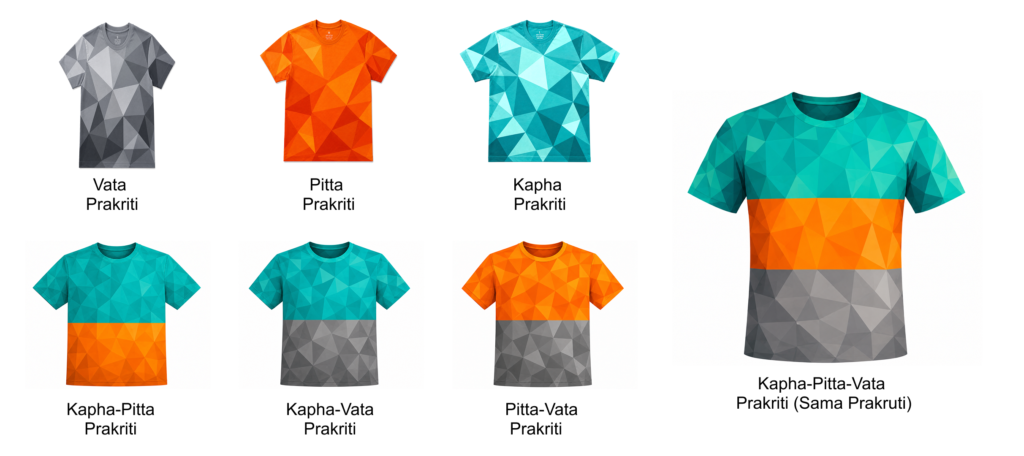
Understanding the Three Doshas
Each Dosha has its own qualities (Gunas), which influence the characteristics of an individual.
1. Vata Prakriti – Associated with Movement
Vata Dosha is characterised by the following qualities:
- Dry (Ruksha)
- Light (Laghu)
- Mobile (Chala)
- Cold (Sheeta)
- Rough (Khara)
- Subtle (Sukshma)
- Unsteady (Vishada)
Vata is associated with movement and various activities in the body.
2. Pitta Prakriti – Associated with Transformation
Pitta Dosha represents transformation and metabolic processes. Its characteristic qualities include:
- Hot (Ushna)
- Sharp (Tikshna)
- Light (Laghu)
- Liquid (Drava)
- Slightly oily (Sneha)
- Spreading (Sara)
- Foul-smelling (Visra)
3. Kapha Prakriti – Associated with Stability
Kapha Dosha is associated with structure, stability and nourishment. Its characteristic qualities include:
- Oily (Snigdha)
- Thick (Sandra)
- Cold (Sheeta)
- Heavy (Guru)
- Slow (Manda)
- Stable (Sthira)
- Soft (Mridu)
Understanding the Combined Prakritis
People with dual-Dosha or triple-Dosha constitutions exhibit characteristics associated with their respective dominant Doshas.
4. Vata-Pitta Prakriti
These individuals exhibit a combination of Vata and Pitta characteristics.
5. Vata-Kapha Prakriti
These individuals exhibit a combination of Vata and Kapha characteristics.
6. Pitta-Kapha Prakriti
These individuals exhibit a combination of Pitta and Kapha characteristics.
7. Vata-Pitta-Kapha Prakriti (Sama Prakriti)
These individuals exhibit characteristics of all three Doshas, with a relatively balanced constitutional proportion.
Why is Knowing Your Prakriti Important?
Understanding Prakriti is an important aspect of Ayurvedic health management. It helps us understand our natural tendencies and make more suitable choices regarding food, daily routines and lifestyle. Each Prakriti has a tendency towards certain imbalances when exposed to factors that aggravate its dominant Dosha. For example, a person with Vata-dominant Prakriti may be more susceptible to Vata-related imbalances when regularly exposed to Vata-aggravating food, irregular routines, excessive activity or other aggravating factors.
Similarly:
- A Pitta-dominant individual may be more susceptible to Pitta-related imbalances.
- A Kapha-dominant individual may be more susceptible to Kapha-related imbalances.
This does not mean that a person will necessarily develop a disease associated with their dominant Dosha. It simply highlights the importance of understanding individual tendencies.
Food and Lifestyle According to Prakriti
Once we understand our Prakriti, we can make informed choices to help maintain the equilibrium of the Doshas.
- Vata Prakriti: Favour suitable nourishing, warm and grounding foods and routines that help maintain Vata balance.
- Pitta Prakriti: Favour suitable cooling, soothing foods and routines that help maintain Pitta balance.
- Kapha Prakriti: Favour suitable light, warming foods and active routines that help maintain Kapha balance.
The same food or lifestyle practice may affect two individuals differently because their Prakritis are different. Ayurveda therefore emphasises an individualised approach rather than following a single diet or routine for everyone.
Prakriti and Ayurvedic Health Management
Knowledge of Prakriti plays an important role in understanding an individual’s health tendencies and planning appropriate Ayurvedic care. An individual’s Prakriti, the current state of the Doshas (Vikriti), digestive capacity, age, season and other factors are considered while deciding suitable food, lifestyle practices and treatment approaches. The objective is to maintain Dosha equilibrium and support overall well-being.
Know your Prakriti. Understand your nature. Make choices that support your balance.
Note: This article is intended for educational purposes and introduces traditional Ayurvedic concepts. Prakriti assessment and individualised dietary or treatment recommendations should be undertaken with guidance from a qualified Ayurvedic practitioner.
Copyright © 2026 Vedic Intelligence™ – All Rights Reserved.