
Art of Eating!
1. Foods to Eat First
At the beginning of a meal, rock salt (Saindhava lavana) and ginger should traditionally be eaten first. According to Ayurveda, these are considered beneficial, appetite-stimulating, and flavour-enhancing, and are believed to help cleanse the tongue and throat. Rock salt is described as sweet in taste, appetite-stimulating, digestive, light, unctuous, palatable, cooling, pleasing to the sight, subtle, beneficial for the eyes, and capable of balancing all three doshas. Ginger is described as helping bowel movement, heavy, sharp, heating, digestive-fire stimulating, pungent, sweet after digestion, dry, and beneficial for balancing Vata and Kapha.
2. The Traditional Sequence of Eating
When sitting down for a meal, pay attention to the food served and take note of the different dishes. According to traditional Ayurvedic guidance:
At the beginning: Eat foods with a predominantly sweet taste.
In the middle: Eat foods with sour and salty tastes. Towards the end: Eat foods with pungent, bitter, and astringent tastes.
Fruits such as pomegranate, apple, fig, and grapes may be eaten in small quantities at the beginning of the meal. However, bananas and cucumbers are traditionally not recommended at the start. The text recommends eating lotus stalk, lotus rhizome, and tender sugarcane before the main meal, rather than at the end. Heavy flour-based foods, chapatis, laddus, poha, and similar items should not be eaten after the meal has been completed. Eat a moderate quantity when genuinely hungry and avoid overeating.
3. The Order of Food by Texture and Consistency
The text recommends beginning the meal with food accompanied by ghee, such as rice with ghee. It further suggests eating solid or firm foods first, soft foods afterwards, and liquids towards the end. According to the traditional text, following this sequence is believed to promote strength and health.
Another passage offers a more detailed variation: Begin with moderately liquid foods. Avoid drinking excessive water immediately after them.
Eat firmer foods, such as laddus, chapatis, bhakris, and vadas, in the middle of the meal. Water may be consumed according to one’s needs at this stage.
Sweet and palatable foods may be eaten progressively.
The text also suggests that a meal is particularly enjoyable when, even after finishing it, one still appreciates the taste of the food eaten.
4. Qualities of Sweet-Tasting Foods
Sweet-tasting foods are traditionally described as bringing happiness to the mind, strength, nourishment, enthusiasm, and pleasure to the tongue.
Foods that do not possess these sweet qualities are described as having qualities opposite to those associated with sweetness.
5. Choosing the Right Temperature and Eating Pace
According to the text, food that is excessively hot may diminish strength, while cold and dry food may be difficult to digest.
Eating rice immediately after cooking, before its steam has subsided, is described as potentially causing discomfort or lethargy. Therefore, food should be eaten at an appropriate temperature and in a suitable condition to be beneficial. Eating too quickly may prevent a person from properly experiencing the qualities or drawbacks of the food. Conversely, eating too slowly may allow the food to become cold and less enjoyable.
6. Understanding Heavy Foods
People with weak or sluggish digestive fire (Mandagni) are traditionally advised to avoid heavy foods. The text describes three categories of heavy foods: Heavy because of quantity (Mātrā-guru): Foods such as green gram and pigeon pea lentils may become heavy when consumed in excessive quantities. Naturally heavy (Svabhāva-guru): Foods such as black gram and field beans are described as naturally heavy to digest. Heavy because of preparation (Saṃskāra-guru): Flour-based preparations, such as dumplings and vadas, may become heavy because of their method of preparation.
These examples are illustrative; the text suggests understanding the properties of different foods in the same way.
7. The Three Dosha Phases During a Meal
The text divides the time spent eating a meal into three phases:
First phase — Vata: Sweet-tasting foods eaten at the beginning are traditionally said to pacify Vata.
Middle phase — Pitta: Sour, salty, and sweet tastes consumed in the middle are described as stimulating digestive fire in the region associated with Pitta.
Final phase — Kapha: Pungent, bitter, and astringent tastes consumed towards the end are traditionally said to pacify Kapha.
These are explanations given in the traditional Ayurvedic framework.
8. Why Is Milk Traditionally Consumed at the End of a Meal?
A question arises: milk is sweet, unctuous, heavy, cooling, and traditionally associated with increasing Kapha. Why, then, does the text recommend drinking it at the end of a meal?
The text explains that certain foods and drinks consumed during a meal may cause a burning sensation or internal heat. Milk is traditionally recommended at the end to soothe this discomfort.
Another explanation is that meals may contain foods and beverages that are salty, sour, pungent, or heating and may cause irritation or a burning sensation. According to this view, a meal should traditionally conclude with a sweet-tasting item, such as milk, to counter these effects.
Editorial note: These recommendations reflect traditional Ayurvedic teachings and should not be interpreted as a universal meal-order rule or as a guarantee of specific health benefits.
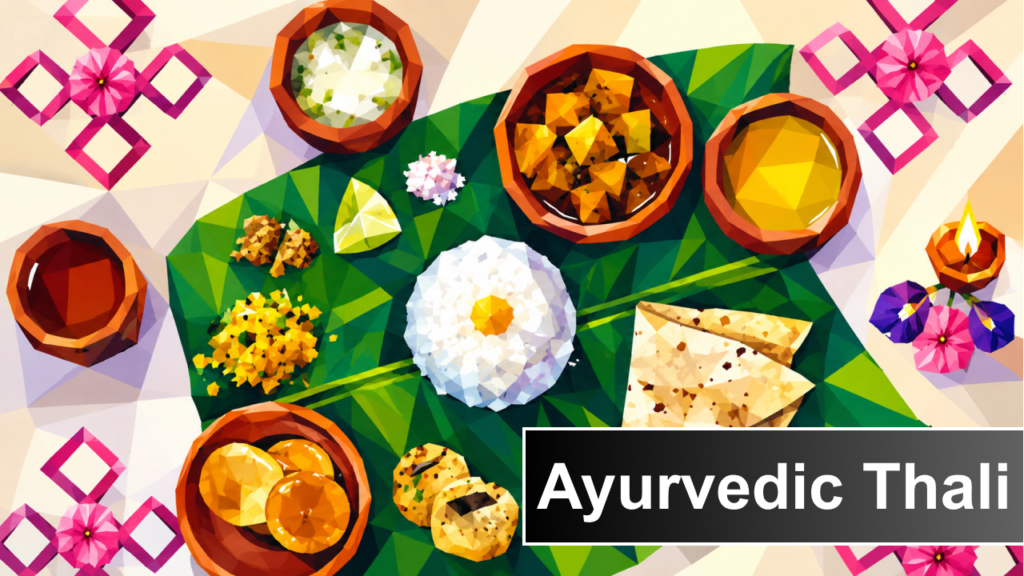
Ayurvedic Thali
– Ginger Chutney
– Dry Moong Dal
– Undarya
– Simple Dal (prepared in the Ayurvedic way) & Rice
– Roti
– Red Pumpkin Vegetable
– Taktav
– Dadhipupak
One the meal is ready, let us offer the Naivedya (food offering) to the deity in the traditional manner and then enjoy the meal.
But before that, let us understand the traditional method of eating a meal.
One should contemplate that food is Brahma, its essence (rasa) is Vishnu, and the person who partakes of the food is Lord Maheshwara (Shiva). With this contemplation, the person eating is said to remain free from the effects of the evil eye.
A plate made from leaves of trees, or a vessel made from leaves, is considered appetite-enhancing and digestive-fire stimulating, and is said to destroy the effects of poison and sin.
At the beginning of a meal, one should consume salt (Saindhava rock salt) and ginger. They are considered wholesome, appetite-enhancing, and stimulating to the digestive fire, and are described as deepana (kindling digestion), pachana (supporting digestion), and beneficial in balancing the three doshas.
Ginger is described as promoting elimination, sharp in its action, and helpful in reducing Vata and Kapha.
Order of Eating — One should begin the meal with foods having a sweet taste (Madhura Rasa). In the middle of the meal, foods with sour and salty tastes should be consumed. Towards the end, foods having pungent, bitter and astringent tastes should be eaten.
At the beginning of the meal, a small quantity of rice with ghee should be consumed. First, hard or firm foods, followed by soft foods, and finally liquid foods should be taken.
Buttermilk should be consumed at the very end, followed by Tambula (betel leaf preparation) after the meal.
Tambula (betel leaf preparation) is described as sharp, appetizing, astringent and bitter. It is said to reduce Kapha, bad breath, accumulated waste, gas and fatigue, while helping to keep the mouth clean and fragrant and the tongue clean.
Fill half the stomach with solid food, one-quarter with liquids, and leave one-quarter empty. According to Ayurveda, this space supports proper digestion. Think of the stomach like a mixer—leaving some room allows food to move and mix properly.
Copyright © 2026 Vedic Intelligence™ – All Rights Reserved.