
The Positions of the Tridoshas

Tridoshas in the Human Body
According to Ayurveda, Vata, Pitta and Kapha pervade the entire body. However, each Dosha has certain regions and tissues where its presence and functions are particularly prominent.
Broadly, the body can be viewed in three regions:
- Vata — predominantly associated with the region below the umbilicus
- Pitta — predominantly associated with the region between the umbilicus and the heart
- Kapha — predominantly associated with the region above the heart
These broad divisions are described in classical Ayurvedic literature, along with more specific sites associated with each Dosha.
Sites Associated with Vata
Vata is particularly associated with the large intestine, pelvic/lumbar region, thighs, bones, ears and skin. The large intestine (Pakvashaya) is regarded as an especially important site of Vata.
Sites Associated with Pitta
Pitta is associated with the region around the umbilicus, stomach and small-intestinal region, sweat, blood, nutrient fluids, eyes and skin. The digestive region around the umbilicus is considered particularly important for Pitta.
Sites Associated with Kapha
Kapha is particularly associated with the chest, throat, head, joints, stomach, nutrient fluids, muscle tissue, adipose tissue, nose and tongue. Among these, the chest is considered an especially important site of Kapha.
Tridoshas and the Stages of Life
Ayurveda also describes a relationship between the Doshas and the natural stages of life.
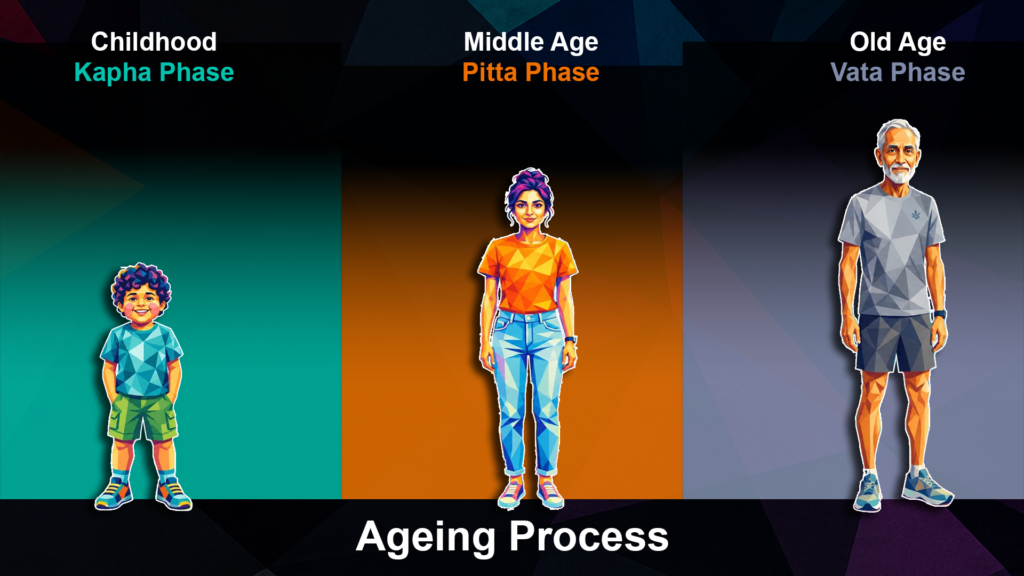
Traditionally:
- Childhood — Kapha predominance
- Adulthood / middle age — Pitta predominance
- Old age — Vata predominance
Classical descriptions associate childhood with growth and development, adulthood with strength and metabolic activity, and old age with increasing dryness and degenerative changes.
For a simple modern presentation, you could describe these stages approximately as:
| Stage | Approximate age | Predominant Dosha |
| Childhood | 0–18 years* | Kapha |
| Middle age | 18–60 years* | Pitta |
| Old age | 60+ years* | Vata |
*These age ranges are a simplified modern presentation; classical Ayurvedic texts use somewhat different age divisions. For example, one discussion of Charaka’s classification places childhood up to about 16 years and middle age up to 60.
Kapha — The Phase of Building
Kapha is traditionally associated with growth, nourishment, stability and structural development. Therefore, the Kapha-dominant period of childhood is viewed as a time of building and development.
Pitta — The Phase of Transformation
Pitta is associated with digestion, metabolism and transformation. Its predominance during adulthood is traditionally connected with the body’s active phase of metabolism and function.
Vata — The Phase of Change and Decline
Vata is associated with movement, dryness and change. With advancing age, the body naturally undergoes changes such as dryness, loss of tissue strength and reduced stability; Ayurveda traditionally relates these tendencies to increasing Vata.
Traditional Ayurvedic Perspective on Age-Related Changes
Within the Ayurvedic framework, different age-related tendencies may be associated with Dosha predominance:
Childhood — Kapha:
Growth, development and nourishment are prominent. Traditional Ayurvedic descriptions may associate Kapha predominance with tendencies such as mucus, congestion and sluggish digestion.
Adulthood — Pitta:
Transformation and metabolism are prominent. Traditional Ayurvedic descriptions associate Pitta predominance with digestive and metabolic disturbances when Pitta becomes aggravated.
Old age — Vata:
Dryness and degeneration become more prominent. Traditional Ayurvedic descriptions associate Vata with tendencies such as dryness, wrinkles, constipation, reduced muscle strength, aches and joint-related complaints.
Note: These are descriptions from the traditional Ayurvedic framework. They should not be interpreted as establishing that a particular Dosha causes a specific modern medical disease or symptom.
Copyright © 2026 Vedic Intelligence™ – All Rights Reserved.